How to Start a Company in Qatar

Starting a business in Qatar involves a series of practical steps: picking the right activity, choosing a legal structure, preparing your documents, and working through registration and licensing with the relevant authorities. It’s not complicated once you know the order things happen in, but it does help to understand what’s ahead before you begin.
This guide is written for foreign investors, Qatar residents, individual entrepreneurs, and existing overseas companies looking to set up locally. We’ll walk through company types, ownership rules, required documents, the registration process, licensing, costs, timelines, and what happens once your company is officially formed. If you’d rather have someone handle the process for you, Hiremate’s company formation services in Qatar cover registration, licensing, and compliance from start to finish.
1. Who Can Start a Company in Qatar?
Several types of people and entities can register a company in Qatar:
- Qatar residents setting up a local business
- Foreign investors looking to enter the Qatari market
- Individual entrepreneurs starting on their own
- Existing overseas companies wanting a branch or representative presence in Qatar
Each of these comes with a slightly different path, mostly around documentation and the type of approval needed from the relevant authority.
Can Foreigners Start a Company in Qatar?
Yes, foreigners can start a company in Qatar. The country actively encourages foreign investment, and there are several legal structures designed specifically for non-Qatari investors. That said, the exact rules — including how much of the company you can own — depend on the business activity and the authority overseeing it.
How to Start a Business in Qatar as a Foreigner
Before choosing a company structure, first confirm a few practical details:
- Whether your chosen business activity allows full foreign ownership or needs a local partner.
- Which authority will handle your registration, such as the Ministry of Commerce and Industry, QFC, or a free zone authority.
- Whether your business requires a physical office or approved commercial space.
- Which documents may need attestation or certified translation.
Checking these requirements at the beginning can help you avoid delays and unnecessary changes later.
2. What Types of Companies Can You Set Up in Qatar?
There isn’t one single way to set up a company in Qatar. The right structure depends on what you’re doing, who’s involved, and where you plan to operate.
Limited Liability Company (LLC)
A common choice for both Qatari and foreign investors. It can suit many business activities and generally limits each shareholder’s liability to their investment in the company.
Branch Office
This option is usually used by an overseas company that needs to operate in Qatar for a specific project, contract, or business assignment.
Representative Office
A representative office is mainly used for promotion, market research, and business coordination. It is not normally set up to carry out direct commercial sales.
Free Zone Company
A company established in one of Qatar’s free zones may follow different rules for ownership, licensing, and tax treatment compared with a mainland company.
Qatar Financial Centre (QFC) Company
A QFC company operates under the Qatar Financial Centre framework and is commonly used by eligible professional, financial, and service-based businesses.
The best company structure depends on your planned activity, ownership preference, target customers, licensing route, and office requirements.
3. Can Foreigners Own 100% of a Company in Qatar?
In many sectors, yes — 100% foreign ownership is possible in Qatar. This has become more common over recent years as Qatar has opened up its investment laws.
However, eligibility isn’t automatic. It depends on:
- The specific business activity you plan to carry out
- Which authority regulates that activity
- Whether that activity falls under any restricted or reserved categories
Because of this, it’s best not to assume 100% ownership will be approved for your case until you’ve confirmed it with the relevant authority.
How to Open a 100% Ownership Company in Qatar
To apply for full foreign ownership, you first need to confirm your business activity and check whether it is eligible under Qatar’s current investment rules. The application is then submitted through the relevant authority, such as the Ministry of Commerce and Industry or the appropriate investment platform.
Approval is reviewed based on the specific business activity and setup, so the requirements and outcome may differ from one company to another.
4. Can You Start a Company in Qatar From Home?
Some business activities may allow you to operate without a large commercial office, but this isn’t true across the board. Most company registrations still require a physical business address, even if it’s a small office rather than a full commercial space.
Whether a home-based setup works for you depends on:
- The type of business activity
- The licence category required for that activity
- Municipality and authority rules tied to your structure
Not every business can legally operate from a residential address, so it’s worth checking this before you commit to a company type.
5. Documents Required to Start a Company in Qatar
Having your paperwork ready in advance makes the whole process move faster. Here’s a practical checklist.
Personal Documents
- Passport copies of all shareholders
- Qatar ID, where applicable
- Contact details for shareholders and managers
- Shareholder background information
Company Documents
- Proposed company name (and backup options)
- Business activity details
- Shareholder documents and ownership breakdown
- Articles of Association or Memorandum, where applicable
- Authorisation documents, such as power of attorney if someone is applying on your behalf
Foreign-Issued Documents
If any documents were issued outside Qatar, they may need to go through additional steps, such as:
- Attestation in the country of origin
- Embassy legalisation through the relevant embassy or consulate
- Certified translation into Arabic
These steps can take time, so it’s worth starting them early rather than leaving them until the last stage of registration.
6. Step-by-Step Process to Start a Company in Qatar
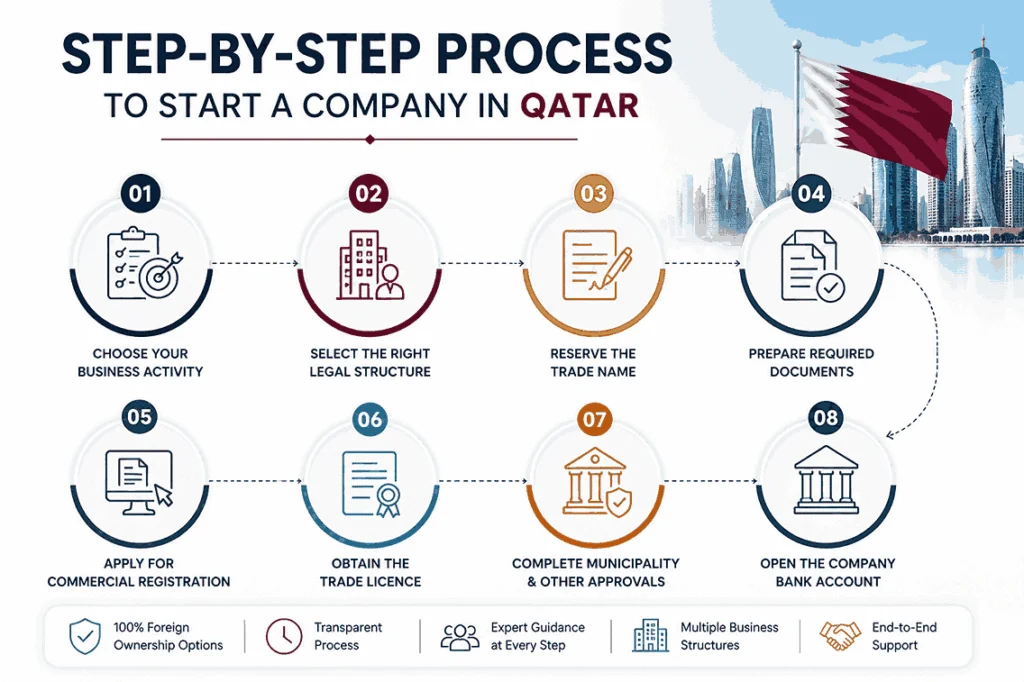
Here’s how the process generally unfolds, though the exact order and requirements can shift slightly depending on your business activity and structure.
Step 1: Choose Your Business Activity
This decision shapes almost everything that follows — your legal structure options, ownership possibilities, licensing requirements, and even your office needs.
Step 2: Select the Right Legal Structure
Based on your activity and ownership goals, decide between an LLC, branch, representative office, free zone company, or QFC entity.
Step 3: Reserve the Trade Name
Submit your proposed company name for approval. Having a couple of backup names ready avoids delays if your first choice isn’t available.
Step 4: Prepare the Required Company Documents
Gather personal, company, and (if needed) foreign-issued documents, making sure attestation and translation are handled where required. Any document that needs signature witnessing or a certified true copy can also go through notary services at this stage.
Step 5: Apply for Commercial Registration
Submit your application to the Ministry of Commerce and Industry or the relevant authority for your structure.
Step 6: Obtain the Trade Licence
Once your commercial registration is approved, apply for the trade licence that matches your business activity.
Step 7: Complete Municipality and Other Required Approvals
Depending on your activity, you may need municipality approval, civil defence clearance, or sector-specific sign-off from another authority. This is also where PRO services come in handy, since they involve a lot of government liaison work.
Step 8: Open the Company Bank Account
With your registration and licence in hand, you can open a corporate bank account, which is usually needed to complete operational setup and, in some cases, to finalise capital deposit requirements.
7. How to Start a Company in Qatar Online
A good part of the registration process can now be handled digitally, particularly through government portals such as the Ministry of Commerce and Industry’s online system and the Invest Qatar single-window platform.
Online, you can typically:
- Submit trade name reservation requests
- Apply for commercial registration
- Track the status of your application
- Submit certain supporting documents digitally
That said, some steps — such as document attestation, certain approvals, or opening a bank account — may still require in-person action or physical paperwork. It’s not a fully remote process from start to finish, but the digital tools do cut down on a lot of the manual back-and-forth.
How to Register a Company in Qatar Online
To register online, you’ll usually need to create an account on the relevant government portal, submit your proposed activity and structure details, upload your documents, and pay the applicable fees. From there, the system will guide you through the remaining steps, flagging anything that still needs to be completed in person.
8. How to Open a Company in Qatar Free Zone
Setting up in a Qatar free zone means registering your company under the rules of a designated free zone authority rather than the standard mainland framework. This can suit businesses in sectors like logistics, technology, manufacturing, or media, depending on which zone you’re looking at.
Before choosing this route, consider:
- Whether your business activity is actually permitted within that free zone
- The ownership structure allowed under free zone rules
- Licensing requirements specific to the zone
- Office or warehouse space requirements, which are often tied to the zone itself
Free zones can offer advantages, but not every business is eligible or a good fit, so it’s worth checking the specific zone’s activity list before assuming this is the right path.
9. What Licences and Approvals Are Required?
The licences and approvals you’ll need depend heavily on what your business actually does. Common ones include:
- Commercial Registration — the foundational registration for your company
- Trade Licence — permits you to operate under your chosen activity
- Municipality approval — often needed for your business premises
- Activity-specific approval — required for regulated sectors like healthcare, education, food, or finance
- Other authority approvals — depending on your structure, this might include QFC, free zone authorities, or other regulators
Not every business needs every approval on this list. A consulting firm and a restaurant, for example, will have very different licensing paths.
10. Office Address and Commercial Space Requirements
Most company structures in Qatar require a registered business address. For some, this needs to be dedicated commercial premises with a formal lease agreement; for others, a smaller office setup may be enough.
Office requirements generally vary based on:
- Your legal structure
- Your business activity
- The licensing authority overseeing your setup
This ties back to the earlier question about working from home — since address requirements differ by activity and structure, it’s worth confirming what’s needed before signing any lease.
11. Do You Need a Local Partner or Sponsor?
This depends on your legal structure and business activity, so there isn’t a single yes-or-no answer that applies to everyone.
Some activities now allow 100% foreign ownership without a local partner. Others still require Qatari participation, or involve administrative arrangements (sometimes called sponsorship) that are separate from actual ownership. It helps to understand the difference between the two:
- Ownership relates to who legally holds shares in the company
- Administrative or sponsorship arrangements can involve local support for certain procedural matters, without necessarily affecting ownership
Because rules vary by activity and authority, it’s worth checking your specific case rather than assuming either outcome.
12. Cost of Opening a Company in Qatar
There’s no single fixed price for starting a company in Qatar — costs depend on your structure, activity, and how much support you need along the way. Here’s a general breakdown of where costs typically come from:
Registration Fees
Charged by the Ministry of Commerce and Industry or the relevant authority for processing your commercial registration.
Licensing Fees
Tied to your trade licence and any activity-specific licences you need.
Office or Commercial Space
Costs vary widely depending on location, size, and whether you’re leasing a full office or a smaller commercial space.
Translation and Attestation Costs
If you’re using foreign-issued documents, translation and attestation fees can add up, especially if multiple documents are involved.
Activity-Specific Approvals
Certain sectors — like healthcare or food — involve additional inspection or approval fees, and may also need documents to go through MOFA attestation or the Ministry of Justice SAK system.
Professional Service Fees
If you use a company formation service, PRO, or legal advisor, their fees will factor into your overall budget.
Because these costs shift based on your specific setup, it’s best to get a tailored estimate rather than relying on a general figure.
13. How Long Does Company Formation Take in Qatar?
There’s no guaranteed timeline, since several factors affect how quickly your company gets registered:
- The type of company structure you’re setting up
- Your business activity and whether it needs extra approvals
- How ready your documents are when you start
- Processing times at the relevant government authorities
- Whether any documents need foreign attestation, which can add time
- How quickly you can finalise office arrangements
- Bank account setup, which can vary between banks
Some straightforward registrations move relatively quickly, while others — particularly those involving regulated activities or foreign document attestation — take longer. It’s sensible to build some flexibility into your planning rather than working around a fixed date.
14. Common Mistakes to Avoid When Starting a Company in Qatar
A few recurring issues tend to slow people down or create extra costs:
- Choosing a business activity that doesn’t match what you actually plan to do
- Selecting a legal structure that doesn’t fit your ownership goals
- Submitting incomplete documents
- Getting shareholder details wrong or inconsistent across documents
- Using foreign documents that haven’t been properly attested
- Missing required certified translations
- Assuming 100% ownership applies without confirming it first
- Signing an office lease before confirming what your licence actually requires
- Overlooking activity-specific approvals until late in the process
Most of these come down to rushing the early planning stage. Taking time to confirm activity, structure, and requirements upfront tends to save time overall.
15. What Happens After Your Company Is Registered?
Registration is really the starting point, not the finish line. After your company is set up, there are usually a few more things to sort out:
- Finalising licences if any activity-specific approvals are still pending
- Opening or activating your bank account, if not already done
- Tax-related registration, where applicable to your business
- Immigration and labour setup, if you plan to hire staff or sponsor employees, often coordinated through PRO services
- Employee documentation, including contracts and work permits
- Corporate compliance, such as maintaining proper records
- Renewals, since licences and registrations typically need periodic renewal
Staying on top of these steps helps you avoid compliance issues down the line.
16. How Company Formation Services Can Help
Setting up a company involves a lot of moving parts, and it’s easy to lose track of a document or miss a step, especially if you’re doing this from outside Qatar. This is where a company formation service can be useful.
They can typically support you with:
- Reviewing your documents before submission
- Helping you choose the right business activity
- Preparing registration paperwork
- Handling translation and attestation
- Managing government submissions
- Providing PRO (Public Relations Officer) support for administrative tasks
- Coordinating licensing across different authorities
Working with an experienced service doesn’t guarantee approval — that decision always rests with the relevant government authority — but it does reduce the chances of delays caused by paperwork errors or missed requirements. Hiremate Services has supported businesses and individuals in Qatar for over 13 years, handling everything from company registration to attestation and PRO support under one roof.
17. Frequently Asked Questions About Starting a Company in Qatar
Can a foreigner start a company in Qatar? Yes. Foreign investors can set up companies in Qatar, with several legal structures available depending on the business activity.
Can I own 100% of my company in Qatar? In many sectors, yes, though this depends on your specific business activity and the authority regulating it. It’s not guaranteed across every sector.
Can I register a company in Qatar online? Parts of the process can be completed online through government portals, though some steps may still require in-person action or physical documents.
Can I start a company in Qatar from home? Some activities may allow a smaller office setup, but most registrations still require a physical business address. This varies by activity and licence type.
How much does it cost to open a company in Qatar? Costs vary based on structure, activity, office requirements, and document processing. There’s no single fixed price.
Do I need a local partner to start a company in Qatar? It depends on your legal structure and business activity. Some activities allow full foreign ownership, while others involve local participation or administrative arrangements.
How long does company registration take? Timelines vary based on company type, document readiness, and required approvals. There’s no fixed guaranteed date.
What documents are required to register a company? Generally, personal documents (passport copies, ID), company documents (activity details, shareholder information), and, if applicable, attested and translated foreign documents.
Can I open a company in a Qatar Free Zone? Yes, if your business activity is eligible under that specific free zone’s rules. Not every activity qualifies for every zone.
Final Thoughts
Setting up a company in Qatar follows a fairly logical path: choose the right activity, select a company structure that matches your ownership goals, prepare your documents, complete registration and licensing, secure any required approvals, and handle the post-registration steps that follow.
Every business is a little different, and requirements can shift depending on your activity, structure, and the authority involved. If you’d rather not navigate all of this alone, Hiremate’s company formation services in Qatar can help review your documents, guide you through registration, and manage the coordination with different authorities on your behalf. You can get in touch here to discuss your specific case.